Walmart Just Put Its Shelf Inside Google's AI. Here's Exactly What Changes — For Brands and Shoppers.
The headline everyone shared this summer was some version of "Walmart is going into Google's Gemini." True, but it buries the part that actually matters. Walmart is one of the launch partners of Google's Universal Cart and its underlying Universal Commerce Protocol (UCP) — the machinery that lets an AI agent discover, compare and buy across many retailers without a human ever opening a product page.
So instead of another hot take, we did the boring, useful thing: we pulled the primary coverage, separated what's confirmed from what a few outlets embellished, and wrote the step-by-step version of what this looks like for a shopper and for a brand. No hype, no hallucinations — sources at the bottom.
What actually launched (the confirmed version)
Across Google I/O 2026 (May 19) and Google Marketing Live 2026 (May 20), Google rolled out three connected pieces:
- Universal Cart — one persistent cart that lives across Google Search, the Gemini app, YouTube and Gmail. You add products from multiple retailers and check out in one tap with Google Wallet, or hand off to the retailer's own checkout. Launch partners include Walmart, Nike, Sephora, Target, Ulta Beauty, Wayfair and Shopify merchants like Fenty and Steve Madden.
- UCP (Universal Commerce Protocol) — the open standard Google released in January 2026, updated in March, that gives retailers a common language to connect their product catalog, checkout and payment across Google's AI surfaces. It also handles identity linking, so your loyalty benefits survive a purchase made through Google.
- AP2 (Agent Payments Protocol) — the framework that lets an agent actually pay. You set the brand, product and spending limit; the agent only buys when your criteria are met, backed by a cryptographically signed "Mandate" that creates a tamper-proof audit trail. Its April 2026 update even added "Human Not Present" purchases.
Walmart's own assistant, Sparky, remains Walmart's in-house AI shopping layer. The confirmed news is that Walmart's catalog plugs into Google's agentic surfaces via UCP — not, as one crypto outlet framed it, a stage-managed "Sparky-inside-Gemini" keynote. We flag that in the fact-check below.
Part 1 — What it looks like for the shopper
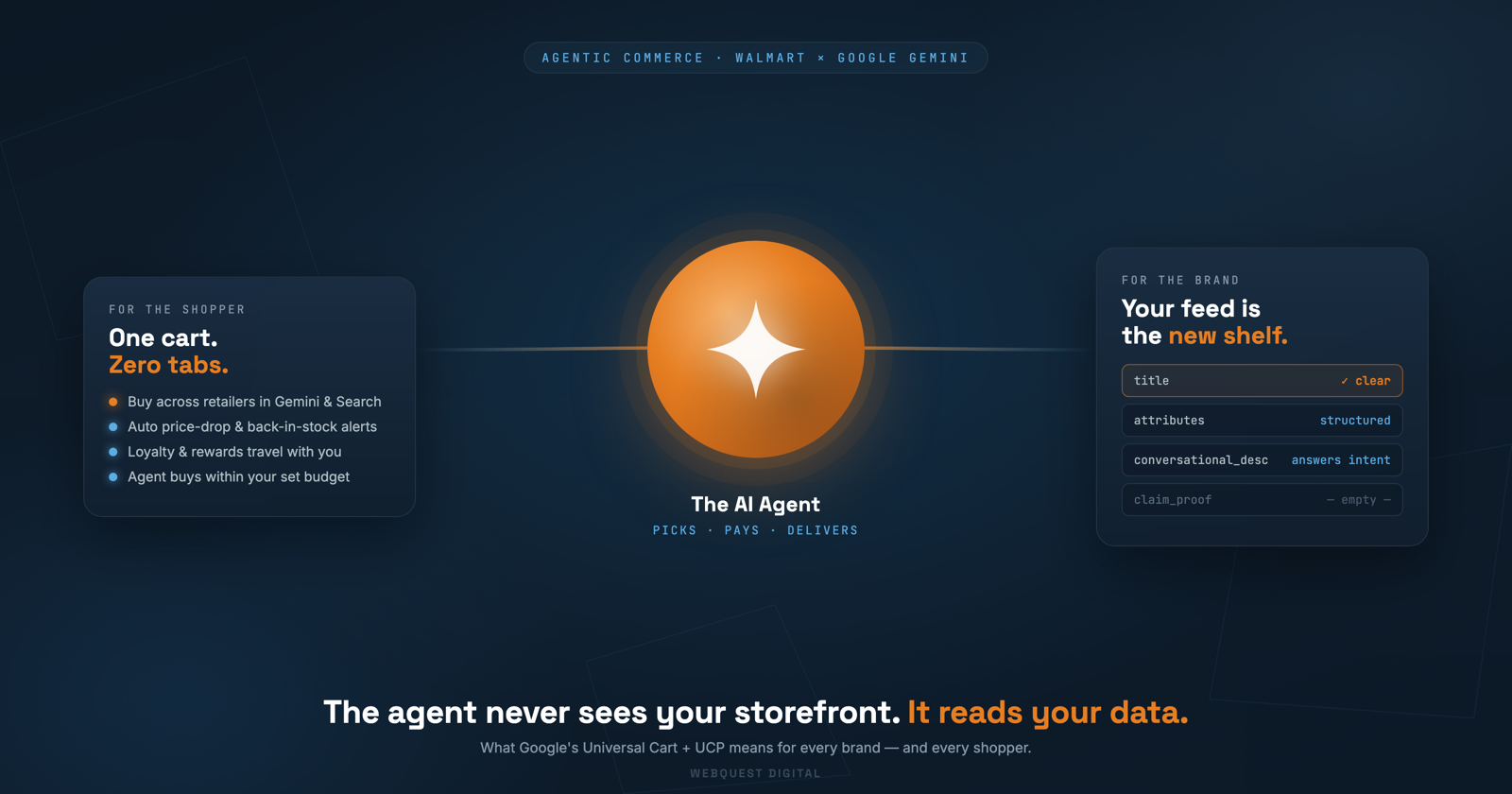
Start with the human, because the consumer benefit is what drags brands along. Here's the journey Google is building toward, end to end:
The shopper's loop: one instruction, one cart, one checkout — across many stores.
The concrete benefits (and why they land)
| What changes | Why a shopper cares |
|---|---|
| One persistent cart across Search, Gemini, YouTube, Gmail | No more eight tabs and four logins. Add a Walmart pantry item and a Nike gift to the same cart, check out once. |
| Proactive AI — price-drop tracking, price history, back-in-stock alerts | Google's demo flagged product incompatibilities in a PC build and suggested alternatives. Fewer wrong buys, more caught savings. |
| Loyalty that travels via Google Wallet identity linking | Your Walmart rewards, card perks and merchant offers are surfaced automatically — even when you buy through Gemini. |
| Delegated buying via AP2 within a set budget | "Buy it when it drops below $X." The agent acts autonomously, but inside guardrails, with a signed audit trail. |
| Financing built in — Affirm & Klarna inside Google Pay | Buy-now-pay-later at the moment of decision, without leaving the conversation. |
The honest trade-off: you hand more of the decision — and your payment credentials — to an assistant. That raises real questions about trust, privacy and "what happens when the agent buys the wrong thing." AP2's signed Mandates and spending limits are Google's answer, but consumer comfort is still the biggest brake on adoption.
Part 2 — What it looks like for the brand
Now the part every ecommerce and brand team should read twice. When the agent does the shopping, the agent never renders your storefront. It doesn't see your hero banner, your art direction or your carefully designed PDP. It reads your feed — and it recommends what it can clearly understand and verify.
The brand's loop: your product data — not your storefront — is what competes.
The five things that actually shift
| Lever | What it means for your brand |
|---|---|
| A new front door | Your product can be discovered and bought inside Gemini and Search without a site visit. Reach goes up; but so does the risk of losing the direct customer relationship — some retailers already see ~30% traffic drops. |
| The feed is the shelf | Google's new Conversational Attributes (product descriptions written for AI matching) and a complete Merchant Center feed are now your merchandising. An empty attribute isn't cosmetic — it's a reason the agent skips you. |
| Claims must be verifiable | Agents cross-check price, stock and product claims in real time. A claim the agent can't substantiate effectively doesn't exist. |
| Checkout is a choice | Native Google Wallet checkout (frictionless, but Google owns the moment) vs. handoff to your own site (you keep the CRM and data). This is now a strategic decision, not a default. |
| New scoreboard | Google's AI Performance Insights in Merchant Center and Ask Advisor let you see how you show up in AI experiences — the early version of "agentic share of voice." |
The portfolio reality (this is the StratosX view)
Gemini is not the only agent reading your data. The same product now has to be legible to Sparky on Walmart, Rufus and Alexa on Amazon, and Gemini across Google — each with its own way of "reading" a listing. In our audits the pattern is consistent: a product gets recommended only when three things line up — Demand (shoppers actually ask for the benefit), Supply (your content claims it clearly and machine-readably), and Proof (reviews and third-party sources back it up). Agentic commerce doesn't rewrite that physics. It just enforces it automatically, silently, and across every AI shelf at once.
What to do before your category does
You can't control which protocol wins. You can make your brand the one an agent can confidently pick. In order:
- Complete and structure your feed. Full attributes, accurate price and real-time inventory in Merchant Center. This is the price of being considered at all.
- Write Conversational Attributes for real intents. Answer the shopper's situation ("under $80, arrives Friday, good for a family of four") in language an agent can lift verbatim.
- Make every claim provable. If you say it, substantiate it — in the listing, in reviews, in sources the agent trusts.
- Decide your checkout posture. Frictionless Google Wallet reach vs. owning the customer on your own site — choose deliberately, per line.
- Audit how agents describe you today. Ask Gemini, Sparky and Rufus your category's real questions now, and fix the inaccuracies at the source before they cost a sale.
For twenty years the game was winning a spot on a results page. The agentic shelf changes the object of the game: now you compete to be the option an autonomous buyer can understand, verify and trust enough to buy — without a human ever looking.
Walmart plugging into Universal Cart is not a one-off news item. It's the clearest signal yet that product data is becoming the storefront. The brands that treat it that way — legible to every agent, on every shelf — are the ones still getting recommended when the shopper stops shopping and the agent takes over.
Sources
- Search Engine Land — "Google Search Universal Cart, expands UCP and AP2" (May 19, 2026; Universal Cart, 60B Shopping Graph, launch partners, AP2, availability).
- Search Engine Land — "Google expands Universal Commerce Protocol and launches new agentic shopping tools" (May 20, 2026; Conversational Attributes, AI Performance Insights, Affirm/Klarna, verticals, rollout).
- The Next Web — "Google wants to own your entire shopping journey with Universal Cart and agent-led payments" (May 19, 2026; UCP timeline, AP2 details, McKinsey $5T, ~30% traffic declines, Amazon/Alibaba context).
- Google — Google Shopping blog: Universal Cart announcement (primary source for the cart and partner list).