The First 40 Characters: Where Walmart Titles Win the Search Result
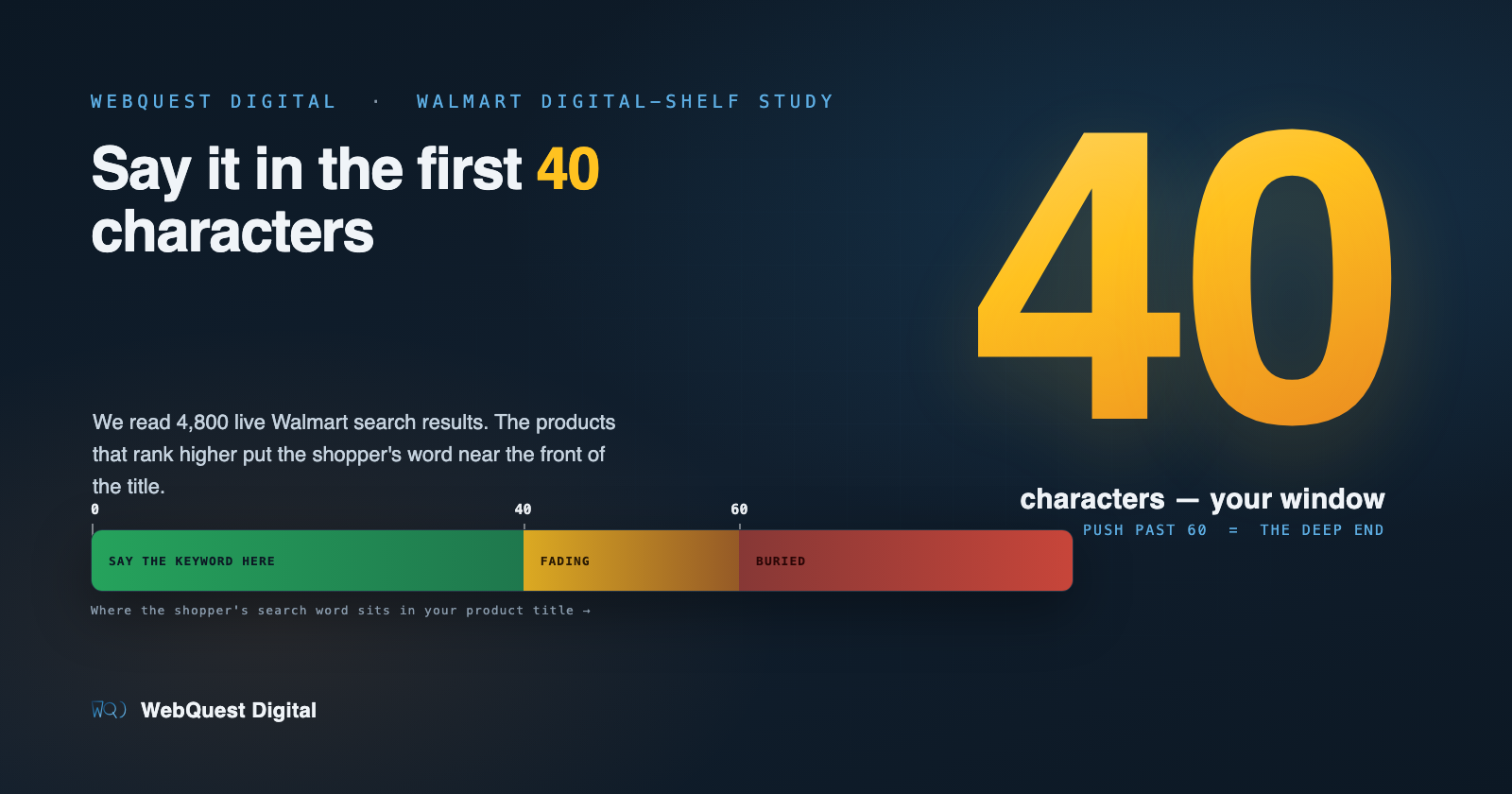
On Walmart, where you place the shopper's word inside your product title isn't decoration — it moves your rank. We read 4,800 live search results across 20 searches, and one pattern held throughout: the higher-ranking products say the searched word near the front, inside the first 40 characters.
Every brand knows a product title should contain the words shoppers search for. Far fewer act on the next question: does it matter where in the title those words sit? On Walmart, our data says it does — and the effect is large enough that a title with the right words in the wrong place can quietly cost you the sale.
To find out, we collected the live Walmart search results for 20 everyday product searches — the kind of generic terms a shopper actually types, not brand names — and looked at 4,800 real products in the order Walmart ranked them. For each one we measured a single, simple thing: how far into the title, counted in characters, the shopper's searched word first appears. Then we compared that distance to the product's position on the results page.
Finding 01 — Earlier wins
The front of the title is where the searched word belongs
The results were consistent, not subtle. Products that put the shopper's word right at the start of the title — inside the first 20 characters — ranked best on average. Products that got the word in a little later, up to about 40 characters, ranked almost as well. In other words, there is a comfortable window at the front of the title, and if the searched phrase lands anywhere inside it, you're in good shape.
This isn't one lucky category or a handful of listings. It's the same tendency showing up again and again across all twenty searches and thousands of products — a clear, repeatable pattern rather than a coincidence. When a signal is that consistent across that many listings, it's telling you something real about how the shelf reads your title.
Finding 02 — Past 60 is the deep end
Once the word slips past 60 characters, the floor drops out
The other half of the story is what happens when the searched word shows up late. Products whose keyword didn't appear until after the 60-character mark ranked dramatically worse — their average position was about 67% lower than the products that led with the word. Put plainly: burying the phrase deep in a long, stuffed title is close to not having it there at all.
And listings that never included the searched word anywhere in the title did worst of all. That part is intuitive. The surprise is how steep the penalty is for merely putting the right word in the wrong spot — a title can technically "contain the keyword" and still behave, at the shelf, like it doesn't.
Illustrative example. Both titles contain "water bottle" — but only the second one puts it where the Walmart shelf rewards it.
Why it happens
One title, one job: answer the search fast
The mechanism behind the numbers is not mysterious. A Walmart title has one job on the results page: to confirm, instantly, that this product is the thing the shopper just asked for. When the searched word is the first thing they read, that confirmation is immediate — for the shopper skimming a phone screen, and for the algorithm matching the query. When the word is stranded at character 70, behind a wall of "premium," "reusable," "double-wall," the answer arrives late, and both readers lose confidence.
A title that opens with adjectives is making the shopper — and the shelf — work to find the answer. A title that opens with the searched word hands it over on sight.
This is also why one title should serve one search intent. Long, keyword-stuffed titles usually exist because a listing is trying to win two different searches at once, so it front-loads neither. The fix isn't a longer title — it's a clearer one, or in some cases a second listing for the second intent.
What to do
Put it to work in four moves
- Lead with the searched phrase. Structure the title as brand → what the product is (the searched term) → one or two distinguishing attributes. Get the shopper's word inside the first 40 characters — ideally the first 20.
- Move descriptors back. "Premium," "reusable," "double-wall" and the rest are fine — just not before the word people actually type. They belong after the phrase, not in front of it.
- Don't let the title run so long the keyword drifts past 60. If your searched word is landing that deep, the title is doing too many jobs. Shorten and re-order.
- One listing, one intent. If a SKU is chasing two very different searches, that's a signal for two focused titles, not one stretched one.
The short version
On Walmart, containing the keyword isn't enough — position is the lever. Across 4,800 live search results, the products that led with the shopper's word ranked best, the safe window was the first 40 characters, and letting the word slip past 60 came with about a 67% worse average position. Say what the shopper searched for first. Everything else is a descriptor.
Sources
- WebQuest Digital — proprietary Walmart SERP study, 2026: 20 generic US searches, ~4,800 live organic products, keyword character-position vs. rank (primary source for every figure in this article).
- WebQuest Digital — DataForSEO-based digital-shelf ranking studies, 2026 (supporting work on how marketplaces weight reviews, keyword placement and intent).