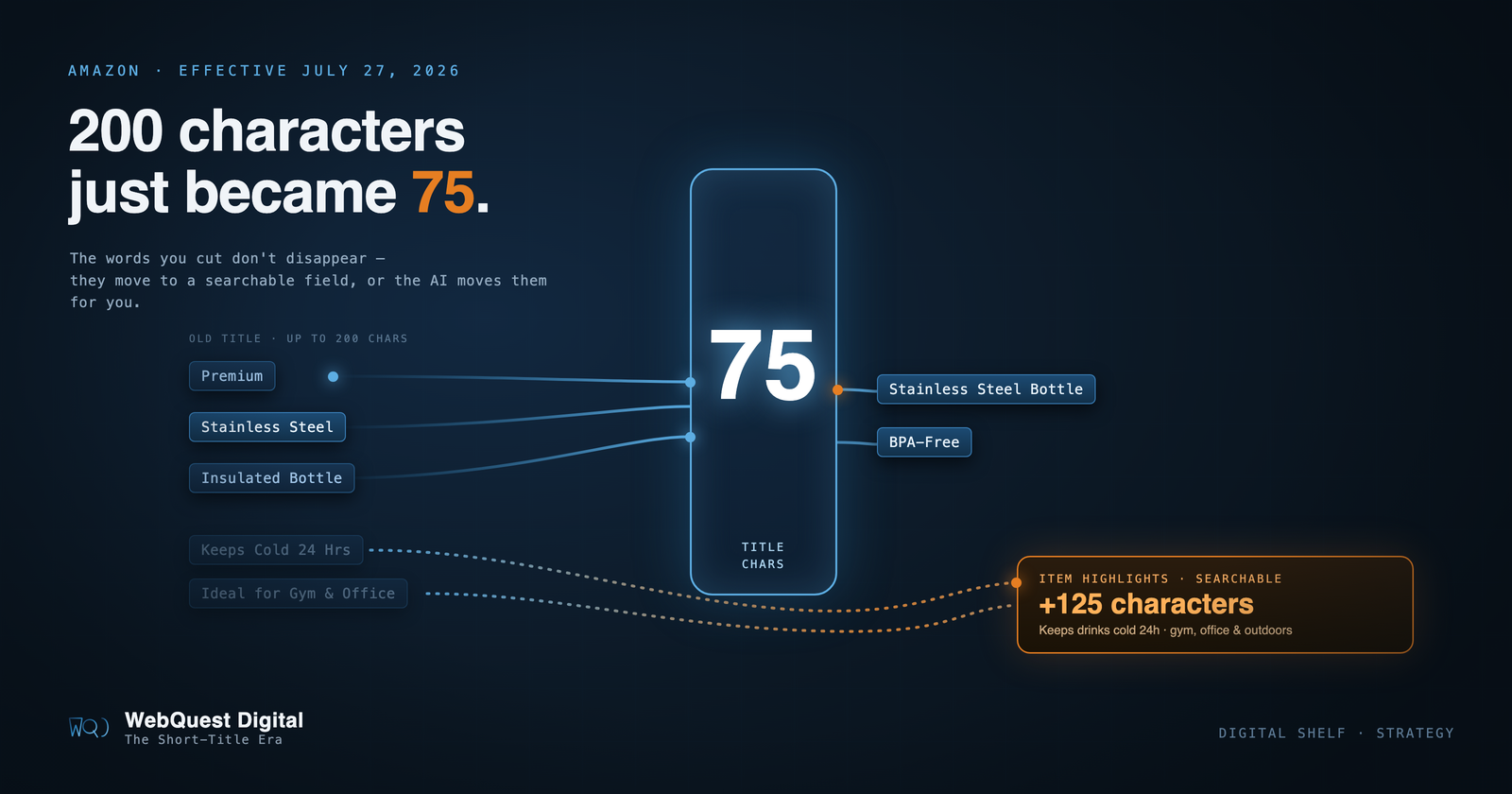
The 75-Character Reset: 9 Considerations for Brands in Amazon's Short-Title Era
On July 27, 2026, Amazon cut the product title from a 200-character keyword warehouse to a 75-character elevator pitch — and handed the overflow to a new searchable field and, if you do nothing, to its own AI. Here is how brands should think about what stays, what moves, and who decides.
For fifteen years, the Amazon product title did two jobs at once. It told a shopper what the product was, and it fed the A9 search engine a dense strip of keywords. Over time the second job won. Titles crept toward the 200-character ceiling, packed with synonyms, use cases and gift occasions, until a phone screen showed you the brand, the product type, and a comma trailing into "…".
That era ended on July 27, 2026. Amazon now caps titles in every category except media (books, music and video) at 75 characters including spaces. The detail that no longer fits doesn't vanish — it moves into a new field called Item Highlights, worth up to 125 searchable characters shown next to your title in both search results and on the product page. And if your title still runs long after the deadline, Amazon's AI will rewrite it for you, gradually, whether you weigh in or not.
This is one of the biggest product-content changes Amazon has made in more than a decade, and it is being framed entirely around the customer: shorter titles display fully on mobile, where most shopping now happens, and they read more consistently against other retailers. But the strategic weight of the change lands somewhere else. As ANavigator's Oleksandr Kovalov put it, "the real work isn't the character count. It's deciding what belongs in those first 75." Here are the nine things we think brands should decide — deliberately, and before Amazon's AI decides for them.
Consideration 01 — Prioritization, not copywriting
The first 75 characters are a triage problem
Seventy-five characters is roughly a dozen words. That is not enough room for a keyword strategy; it is only enough room for a hierarchy. The winning structure is the one Amazon itself recommends and the one our own listing audits keep confirming: brand → what the product actually is → the one or two attributes a shopper needs to tell it apart from the product next to it. Everything else is triage.
This matters more than it looks, because position inside the title is not neutral. In our keyword-rank studies, a search phrase sitting in the first word of a title landed in the top 10% of results about 19% of the time; the same phrase buried at word 10 or later managed only about 9%. A shorter title doesn't just look cleaner — it mechanically pushes your most important terms toward the front, where they carry the most weight. The brands that treat the 75-character cap as a forcing function for clarity will come out ahead of the ones who treat it as a loss.
A worked example Amazon shared with sellers: the temperature and use-case claims don't disappear — they relocate to Item Highlights, where they stay searchable.
Consideration 02 — A second field, not a dumping ground
Item Highlights is searchable — but treat its weight as unproven
The instinct will be to shovel every keyword you cut from the title straight into Item Highlights and call it even. Resist it. The field is genuinely useful — it is indexed for search, it displays alongside your title, and it is the right home for materials, dimensions, compatibility, quantities and specific use cases that help a shopper compare. But it is a separate attribute from your bullet points, it is optional, and Amazon primarily monitors it for restricted content rather than quality.
The open question — the one no one can answer yet — is whether a keyword in Item Highlights carries the same ranking value as the same keyword in the title. Amazon has confirmed the field is searchable; it has not confirmed the weighting is equal. Until that is tested in the wild, the safe assumption is that title real estate is still the most valuable real estate, and Item Highlights is a strong second — not a like-for-like replacement. Write it for comparison, not for volume.
Consideration 03 — Who holds the pen
The 14-day AI window is a safety net, not a plan
Here is the part sellers reacted to most loudly, and it wasn't the character count. After July 27, any title still over the limit gets rewritten by Amazon's AI, and brand owners get 14 days to review, modify or approve those suggestions through the Review Listing Changes tool before they go live. Enrolled brands who ignore that window are handing an automated system the decision of which of their words matter most.
The seller forums filled with the predictable consequence. "The AI wants to make all of my listings generic non-descriptive titles all exactly the same word for word," one wrote. "I'm not against AI, but talk about a nightmare scenario," said another. The complaint underneath both is real: an averaging model, optimizing for compliance, tends to sand down exactly the distinctiveness that makes a listing findable. Treat the 14-day window as the safety net it is — and rewrite your priority listings yourself, so the AI has nothing left to change.
Consideration 04 — Protect what actually sells
Cut words, not conversions
The genuine risk in trimming a title is amputating the search terms that bring you qualified traffic. So before you cut, know which keywords actually earn their place — and here our data offers a useful reframe. Across our ranking studies, the strongest driver of where a product lands is not the title at all: it is review count and rating (Spearman correlations around −0.17 to −0.36, where more reviews means better rank), while price shows essentially no correlation and keyword position is a real but secondary factor.
What that means in practice: the 75-character cap threatens your indexation, not your whole ranking engine. Keep your highest-converting head term in the title, move the long-tail and secondary terms into the searchable Item Highlights field, and don't panic that a shorter title will tank a well-reviewed product. It won't — provided you protect the one or two keywords that were doing the heavy lifting and let your review moat keep doing its job.
Consideration 05 — One listing, one intent
Focus is now the default, so stop stretching
Long titles let brands paper over a structural problem: a single listing trying to win two different shopper intents at once — "protein bar" and "meal replacement," say, or "office chair" and "gaming chair." Two hundred characters could fake it. Seventy-five cannot.
This is a feature, not a bug. Our consistent finding is that one listing should serve one intent; when a product genuinely spans two distant search behaviours, that is a signal for two listings, not one overloaded title. The short-title era rewards the brands who already knew what each SKU was for — and forces a useful reckoning on the ones who didn't.
Consideration 06 — Write for the AI shelf, too
Two readers now: the shopper and the assistant
This change doesn't land in a vacuum. It arrives in the same year Amazon folded Rufus into Alexa+ and started routing real purchase intent through a conversational assistant that reads your listing before it recommends it. A 75-character title and a 125-character highlight aren't just shopper-facing copy anymore — they are structured inputs an AI uses to decide whether your product is the answer to a spoken question.
The cap forces the same discipline the AI shelf already rewards: say clearly what the product is, prove it with specifics, and stop hiding the answer at character 140.
Clarity and comparison-friendly specifics — exactly what Amazon is asking you to move into Item Highlights — are also what an assistant needs to match your product to intent. The brands writing for the machine and the shopper as one audience will find this transition easier than the ones still writing for a keyword-crawler that no longer exists in the old form.
Consideration 07 — Mind the category landmines
75 characters is a floor problem in some categories
The rule is uniform; the reality isn't. In the seller discussions, the sharpest pushback came from categories where mandatory descriptors alone blow past the cap. Fine jewelry is the clearest case: any use of the word "gold" legally requires full karat, color and metal detail ("14kt yellow gold"), and main-stone carat weight must appear in the title under both FTC labeling rules and Amazon's own style guide. Sellers demonstrated compliant titles that already hit 84 characters with nothing left to cut — a genuine conflict between two Amazon requirements.
Art listings often need artist name plus work title before any keyword (an artist's name alone can exceed 50 characters), and toys & collectibles sellers noted that brand, edition, rarity and set information don't realistically fit. Some sellers also hit a hard "100476: Item Highlight currently unsupported" error mid-transition. If you operate in a regulated or descriptor-heavy category, this is where you get expert eyes on the listing before the deadline — compliance risk and search visibility are both on the line, and Amazon has yet to fully resolve the tension.
Consideration 08 — This is an operations problem at scale
For big catalogs, the work is governance, not wording
Rewriting one title is a copy task. Rewriting — or reviewing Amazon's AI rewrite of — thousands of titles, each with a parent and its child variations, plus bundles, plus a 14-day approval clock, is an operations problem. "I have a lot of listings and will not be able to manually complete this in the time we have," one seller wrote. "That will kill my listings."
The mechanics matter here. The 75-character rule applies to both parent and child variation titles and to bundles; the brand name counts toward the limit and must sit at the front; and Item Highlights can be updated at scale through bulk spreadsheet templates or feed APIs. The right response for a large catalog isn't to start editing alphabetically — it's to rank listings by revenue and traffic, hand-write the top of that list, and let the AI window catch the long tail. Whoever owns your catalog needs a prioritized queue and a review workflow, not a heroic weekend.
Consideration 09 — Measure, don't assume
The playbook isn't written yet — so instrument it
Everything above is a starting position, not a settled answer. Nobody yet knows whether Item Highlights index at full weight, how the AI-rewritten titles will perform against hand-written ones, or how much a shorter title moves conversion in a given category. That uncertainty is the reason to treat the next quarter as a measurement exercise.
Two habits carry over directly from our own work. First: verify intent on the live results page, because search volume lies — a high-volume keyword often maps to a shopper looking for something adjacent to what you sell, and 75 characters is far too scarce to spend on the wrong term. Second: watch the before-and-after on your priority ASINs — indexation for your moved keywords, impression share, and conversion — rather than assuming the move was neutral. The brands that instrument this transition will know within weeks what the brands guessing will still be arguing about next year.
The short version
200 characters became 75. The words you cut don't disappear — they move to a searchable second field, or Amazon's AI moves them for you. Decide your own hierarchy before the deadline, protect the keywords that actually convert, write for the assistant as well as the shopper, and measure what happens. The cap isn't the story. Who controls the first 75 characters is.
Sources
- Amazon Seller Central — "Updates to improve your product titles begin on July 27" (announcement thread) and the follow-up "Engage with Amazon" clarification thread (Jun 2026; primary source for the 75-char limit, Item Highlights, the 14-day window, bundles/variations and brand-name inclusion).
- Amazon Seller Central Help — Product title requirements and guidelines (reference page reflecting the updated policy and category/marketplace exclusions).
- Goat Consulting — Reed Thompson, "Amazon Product Title Requirements: The 75-Character Update" (Jun 15, 2026; source for the title formula, the 125-char Item Highlights guidance and the before/after audit approach).
- My Amazon Guy — Steven Pope, "The Amazon 75-Character Title Limit Starts July 27" (Jun 11, 2026; source for the water-bottle example, the jewelry/art/toys category conflicts, the 100476 error, the two-part-title history, and the Kovalov quote).
- Zentail — Lauren Gibson, "Amazon is cutting product titles to 75 characters & introducing AI listing updates" (Jun 15, 2026; source for seller reactions, the Item-Highlights weighting open question, and large-catalog operational impact).
- WebQuest Digital — proprietary DataForSEO Amazon ranking studies, 2026 (source for the reviews/rating vs. price vs. keyword-position findings and the first-word vs. buried-word top-decile rates).