Sparky vs Rufus: The Two AI Shelves Don't Read Your Product the Same Way
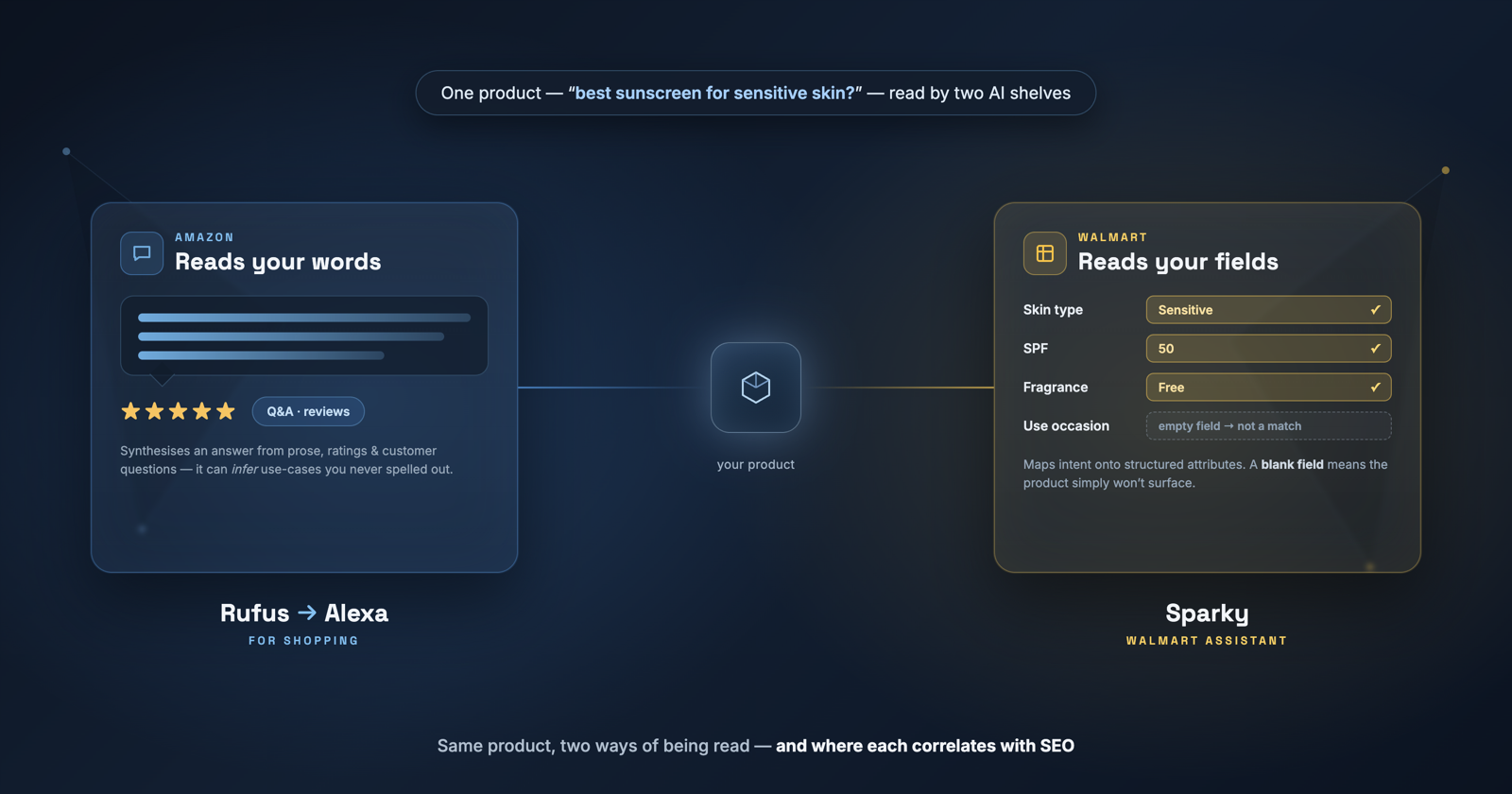
A shopper asks two assistants the same thing — "what's the best sunscreen for sensitive skin?" — on two different apps. On Amazon, the assistant (once Rufus, now folded into Alexa for Shopping) answers by reading your listing copy, your reviews and your community Q&A. On Walmart, Sparky answers by checking whether your catalog has a "skin type" attribute, an SPF field and a "fragrance-free" flag actually filled in.
Same question. Same product. Two completely different ways of being read — and two completely different ways of being missed. This is the part of the AI-commerce shift that most brand teams have not yet internalized: the AI shelf is not one shelf. Amazon and Walmart built their assistants on top of two very different foundations, and that difference dictates how you should write, structure and prove your product on each.
Two assistants, two release stories
Amazon moved first. It announced Rufus — a generative-AI shopping assistant trained on its product catalog, reviews, community Q&A and the wider web — on February 1, 2024, rolling it out across the U.S. through that year. By Amazon's own account, Rufus helped more than 300 million customers in 2025. Then, on May 13, 2026, Amazon merged Rufus, Alexa+ and its shopping tools into a single assistant it now calls Alexa for Shopping.
Walmart's Sparky arrived later and from a different angle. Walmart launched it on June 6, 2025 as a generative-AI assistant inside the Walmart app, built — in Walmart's words — on retail-specific large language models and framed explicitly as the front door to "agentic" shopping. Where Rufus was pitched as a conversation, Sparky was pitched as a way to translate a messy human need ("something for a beach day with toddlers") into the right products in Walmart's structured catalog.
Rufus reads what you wrote about your product. Sparky reads what you filed about your product. That single distinction drives almost everything else.
The core difference: prose vs. structured attributes
Amazon's assistant is fundamentally a text-comprehension engine. It ingests unstructured language — your bullets, your A+ copy, the wording of thousands of reviews, the back-and-forth in customer questions — and synthesizes an answer. If a shopper asks whether a snack is good for a long hike, Rufus can infer "yes" from a review that says "I take these on every trail run," even if you never used the word "hiking" in a single field.
Walmart's assistant leans the other way. Sparky's strength is mapping intent onto structured catalog attributes — size, material, use occasion, ingredients, dietary flags, compatibility. It is very good at narrowing a catalog to the items that genuinely match a constraint, but it leans on the data you actually filed. If the relevant attribute field is empty, the product is far less likely to surface — no matter how strong its off-Walmart reputation is. On Walmart, an unfilled field is a closed door.
Synthesizes an answer from unstructured text:
- Title, bullets & A+ description prose
- Review volume, recency & what reviews say
- Customer Q&A threads
- Can infer use-cases you never spelled out
Maps the shopper's intent onto filed fields:
- Size, material, colour, compatibility
- Use occasion & dietary / ingredient flags
- Listing-quality & attribute completeness
- An empty field usually means "not a match"
Open garden vs. closed garden
There is a second, strategic split. Amazon keeps its assistant inside its own walls: Rufus/Alexa for Shopping lives in the Amazon app and site, and Amazon has been actively restricting outside AI agents and crawlers from operating across its store. Walmart has gone the other way, making its product catalog reachable by third-party assistants such as OpenAI's ChatGPT and Google's Gemini — an "open" distribution play that tries to put Walmart's shelf wherever the shopper is already asking questions.
For a brand, that's not an abstract platform-strategy debate. It changes the surface area. Optimizing for Rufus pays off in exactly one place. Optimizing your Walmart catalog can pay off in several — but only if the structured data travels well, because an external assistant has even less prose to fall back on than Sparky does.
Where each one actually correlates with SEO
Here's the claim worth sitting with: neither assistant replaced search — both were built on top of it. Rufus and Sparky are layers that sit on each retailer's existing retrieval and ranking systems, and they inherit those systems' signals. That's why "AI optimization" on these platforms is not a break from retail SEO. It's retail SEO, intensified.
- Rufus correlates with Amazon's listing/A9 signals. The things that already help you rank and convert on Amazon — keyword-relevant copy, listing depth, and especially review volume, recency and substance plus answered customer questions — are the same things Rufus mines to build an answer. Strengthen the listing and the reviews, and you strengthen both your search rank and your odds of being the product the assistant cites.
- Sparky correlates with Walmart's catalog-SEO and listing-quality signals. Walmart already rewards complete, accurate, attribute-rich listings with better content/Listing-Quality scores and search visibility. Sparky leans on that exact structured layer. Fill every relevant attribute, map use-cases and occasions onto fields, and you lift both classic Walmart search and Sparky eligibility at once.
The common denominator across both assistants is unglamorous and entirely within your control: clean, consistent, machine-readable data; claims you can substantiate; complete attributes; and real, contextual review evidence. Where they diverge is emphasis — Amazon rewards descriptive language and review depth; Walmart rewards structured completeness.
The shopper behaviour driving this
The reason the data discipline matters is that AI shoppers behave differently — they research more, and they bail faster when something doesn't add up.
(Adoption and order-value figures are Walmart's; the shopper-behaviour percentages come from surveys compiled by Envision Horizons — see Sources.)
Read those numbers together and the lesson is blunt: the assistant is not just a discovery channel, it's a gatekeeper that can veto a sale. A contradiction between your title and your attributes, a claim with no proof, a spec left blank — on the old shelf those were soft negatives. On the AI shelf they can become the reason a shopper is steered to a competitor in real time.
What this means for content creators: two architectures, one product
The practical takeaway is that the same product now needs two content architectures, tuned to how each assistant reads. Stop thinking "write the listing once, paste everywhere."
| Dimension | Amazon (Rufus / Alexa) | Walmart (Sparky) |
|---|---|---|
| What the AI reads | Prose, reviews, Q&A — unstructured language | Structured attributes & listing-quality fields |
| Biggest lever | Descriptive copy + review volume/quality + answered questions | Attribute completeness + accurate, mapped fields |
| Where you lose | Thin copy, few/old reviews, unanswered questions | Blank fields, mismatched or generic attributes |
| Distribution | Inside Amazon's walls only | Walmart app + external assistants (ChatGPT, Gemini) |
| Your job | Write richly, prove with reviews/Q&A | File completely, map every use-case to a field |
A working checklist
On Amazon — write for inference: cover real use-cases in descriptive language; seed and answer customer questions; cultivate review volume, recency and specificity; make claims that reviews visibly back up.
On Walmart — write for retrieval: fill every relevant attribute (size, material, occasion, dietary, compatibility); translate "good for a beach day with toddlers" into the literal fields Sparky filters on; never leave a relevant field blank, and never let a field contradict the title.
And the rule that spans both: be impossible to misread. Keep your facts consistent across title, attributes, copy and reviews, and substantiate anything an assistant might be asked to verify. The brands that win the AI shelf are not the ones with the cleverest prompts — they're the ones whose product data leaves the AI no reason to hesitate, on either store.
Sources
- Amazon — "Amazon announces Rufus, a new generative AI-powered conversational shopping experience" (Feb 1, 2024).
- Amazon — "Meet Alexa for Shopping, your personalized, agentic AI assistant on Amazon" (May 13, 2026; Rufus helped 300M+ customers in 2025; Rufus → Alexa for Shopping).
- Walmart Corporate — "The Future of Shopping Is Agentic. Meet Sparky, Our Gen-AI-Powered Assistant" (Jun 6, 2025; launch, retail-specific LLMs, agentic vision).
- Digital Commerce 360 — "Walmart launches Sparky, a generative AI shopping assistant" (Jun 11, 2025).
- Envision Horizons — "Walmart's Sparky Is Changing the Way Shoppers Find Products" (Apr 2026; structured-attribute behaviour, open distribution, AI-shopper survey data, AOV).