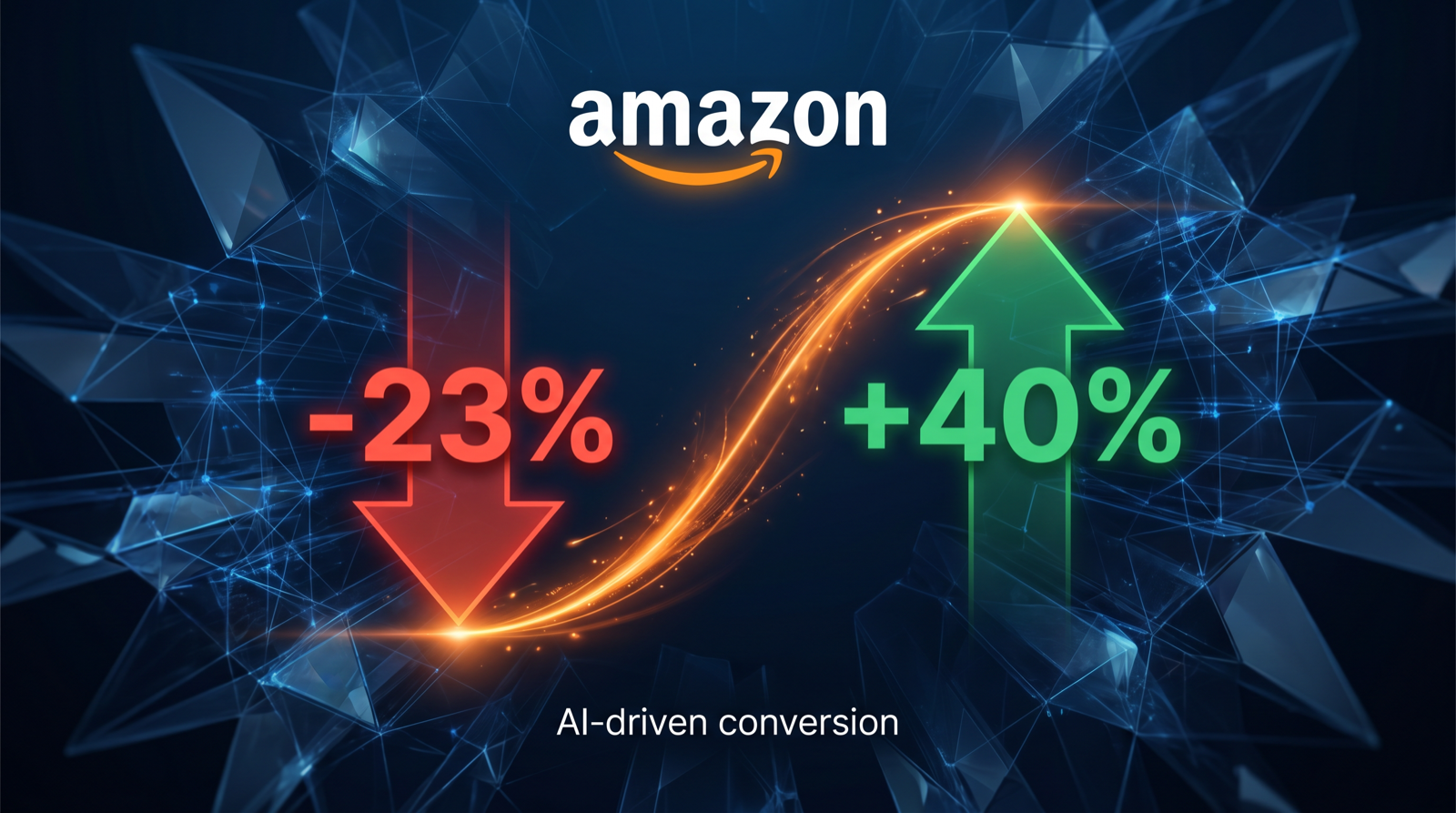
From −23% to +40%: How AI Shopping Flipped Prime Day 2026
A year ago, sending shoppers to checkout via an AI assistant was a bad bet. On Prime Day 2025, traffic arriving from AI sources converted 23% worse than traffic from paid search, email and social. The robots browsed; they didn't buy.
On Prime Day 2026, that number didn't just recover — it inverted. AI-directed traffic converted 40% better than non-AI channels. In twelve months, the worst-converting source of traffic became the best. And it happened in the same window that Amazon quietly retired the Rufus name and rebuilt the experience as Alexa for Shopping.
Source: Adobe Analytics, reported by Forbes (Jun 27, 2026). See full sourcing below.
What the swing actually measures
The figures come from Adobe Analytics, which tracks visits and conversions across a large sample of U.S. retail sites and isolates traffic referred from generative-AI sources — ChatGPT, Gemini, AI-enabled browsers and on-site assistants like Amazon's. A year ago, those visitors behaved like researchers: high curiosity, low intent. They asked, compared, and left.
By mid-2026 the behaviour changed. The same class of traffic now converts 40% above the baseline of conventional paid channels, and there's simply far more of it: AI-referred visits to U.S. retail were up 235% year-over-year from January through May 2026, then jumped 89% again during the Prime Day window itself. Curiosity turned into carts.
In 2025, AI traffic was the worst-converting source on the site. In 2026, it's the best. The assistant stopped being a place people research and became a place people buy.
The year Rufus became Alexa for Shopping
The conversion swing didn't happen in a vacuum. Between the two Prime Days, Amazon overhauled the assistant that sits inside the buying flow.
| Date | What happened |
|---|---|
| Prime Day 2025 | Rufus is live for all U.S. shoppers. Adobe measures AI-directed traffic converting 23% worse than non-AI channels. Amazon later says Rufus helped 300M+ customers across 2025, with monthly active users up 115% YoY. |
| Feb 2026 | Amazon makes Alexa+ free for all U.S. Prime members, setting up the merge of conversational shopping and the broader assistant. |
| Jun 7, 2026 | Ahead of Prime Day, reports put Rufus past 250M users — and flag persistent readiness gaps in catalogs: empty Q&A, thin descriptions, unanswered reviews. |
| May 13, 2026 | Amazon discontinues the standalone Rufus chatbot and folds it into "Alexa for Shopping," embedded in the main search bar — no Prime membership or Echo device required. |
| Prime Day 2026 (Jun 23–26) | $26.4B in U.S. online sales over four days (+9.3% YoY). AI-directed traffic now converts 40% better than other channels and is up 89% YoY. |
Two things were happening at once. The technology got better at closing — more accurate answers, tighter product matching, fewer dead ends. And the distribution got wider — moving the assistant out of a separate chat panel and into the search bar every shopper already uses removed the friction that kept Rufus a research tool.
Shoppers were ready for it
Pre-event survey data lines up with the hard numbers. In a June 2026 survey of 1,500 U.S. shoppers, 58% said they planned to use — or were considering using — AI somewhere in their shopping journey, and half said they'd already tried Alexa for Shopping (the experience formerly known as Rufus).
What they use it for tells you why conversion improved. The top jobs are decision-support tasks that sit right next to the buy button:
These aren't idle queries. A shopper comparing prices and reading a review summary inside the assistant is already deep in a purchase decision. When the assistant answers well, the gap between "asking" and "buying" collapses — which is exactly what the +40% conversion figure captures.
The catch: half your shelf is invisible to the AI
Here's the number every brand should sit with. Adobe found that 46% of retail site content is not machine-readable — it can't be cleanly parsed by the AI agents now driving the best-converting traffic on the platform. Nearly half the digital shelf is illegible to the exact channel that's growing fastest and converting highest.
That's the whole game in one statistic. If AI-directed shoppers now convert 40% better, then any product the assistant can't confidently read or recommend is quietly losing the most valuable traffic on Amazon. The brands riding the swing aren't the ones with the biggest ad budgets — they're the ones whose listings, A+ content, reviews and Q&A give the assistant clear, structured evidence to act on.
What this means for brands
- Make your content machine-readable. Structured, explicit, consistent claims across the listing, A+ modules, reviews and Q&A. The assistant can only recommend what it can clearly understand.
- Answer the high-intent jobs. Price-comparison, price-history and review-summary are the top AI use cases. Your content should make the value, the deal and the verdict easy for an AI to state.
- Audit how the AI answers today. Ask Alexa for Shopping your category's real questions and read what it says about you versus rivals. The gaps are your roadmap.
- Treat AI traffic as your best channel, not a curiosity. The conversion math has flipped. Plan for it like you'd plan for your highest-ROAS paid line.
The bigger picture
For a decade, the Prime Day story was about price and position — the deepest discount, the best slot. The 2026 story is about readability. Amazon spent the year making its assistant trustworthy enough to buy from, and shoppers responded by routing their highest-intent moments through it.
The −23% to +40% swing isn't about AI getting hyped. It's about AI getting good enough to close — and rewarding the brands whose product story is clear enough for a machine to recommend out loud.
Sources
- Forbes / Adobe Analytics — Joan Verdon, "AI Played A Big Role In Prime Day Sales, With 40% Better Conversion" (Jun 27, 2026; source for the −23% / +40% conversion swing, +89% Prime-Day and +235% Jan–May AI-traffic growth, 46% not-machine-readable, and $26.4B / +9.3% sales).
- CNBC — Annie Palmer, "Amazon ditches Rufus chatbot, launches Alexa shopping agent" (May 13, 2026; source for the Rufus → Alexa for Shopping rebrand).
- Stackline — Noah Johnson, "Rufus is gone. What it means, and what it doesn't" (May 13, 2026; source for 300M customers in 2025, +115% MAU YoY, and Alexa+ free for Prime by Feb 2026).
- Stackline Consumer Pulse — "What shoppers are telling us about Prime Day 2026" (Jun 2026; survey of 1,500 U.S. shoppers — source for 58% AI intent, 50% tried Alexa for Shopping, and the 65% / 46% / 25% use-case splits).
- ChannelEngine via NexChron — "Amazon Rufus crosses 250 million shoppers ahead of Prime Day 2026" (Jun 7, 2026; source for the 250M-user milestone and catalog readiness gaps).